Most people judge a tire by its tread. If there is rubber left, it passes.
Tread is only one of the things that can end a tire's life. A tire with plenty of tread can be too old or too cracked to trust, and the tire most likely to be in that state is the spare nobody has looked at in years.
How to read the date code
Every tire sold for US roads has a DOT code molded into the sidewall. The last four digits are the week and the year the tire was made.
The first two digits are the week. The last two are the year. So 2321 means week 23 of 2021, and 0819 means week 8 of 2019.
The date part may be on one sidewall only. If you cannot find it, look at the side facing the car.
A three digit code means the tire was made before 2000. That tire is at least 26 years old. It turns up on trailers, project cars and spares that have never left the trunk.
Check every tire. They are often not the same age. A car that has had two tires replaced has two different clocks running.
How old is too old? There are two camps
Some articles say tires are done at six years. Others say ten. Both are quoting real companies, and the disagreement is genuine. Here is what the companies say in their own guidance.
The six year camp
- Goodyear: replace any tire in service for 6 years or more, including the spare, "even if such tire appears serviceable and even if it has not reached the legal treadwear limit."
- Ford: "Ford recommends you replace your tires every six years or when they wear out, whichever comes first." Ford also says to replace the spare after six years, even if it has never been used.
- Mercedes-Benz: "Replace the tires after six years at the latest, regardless of wear."
- Nissan: have tires over 6 years old, including the spare, checked by a qualified technician, "because some tire damage may not be obvious."
The ten year camp
- Michelin: after five years of service, have tires inspected at least once a year. Replace them ten years after the date they were made, "regardless of remaining tread depth or apparent condition." Michelin adds: "This recommendation includes spare tires."
- Bridgestone: inspect tires regularly after 5 years of service, and take tires more than 10 years old out of service. A spare over 10 years old "may look like a new tire, but it should be replaced."
- Continental: all tires, spares included, made more than ten years ago should be taken out of service and replaced.
- Pirelli: inspect tires more often after five years, and take tires out of service ten years from the date they were made, spares included.
- Toyo: replace tires in service 10 years or more from the date they were made, spares included, "even if such tires appear serviceable."
- Yokohama: once a tire, spare included, has been in use five years or more, have it inspected at least once a year. Replace tires 10 or more years old "even if the tire appears to be undamaged."
- Honda: inspect tires once a year once they reach five years old, and take every tire, spare included, out of service 10 years after it was made, "regardless of their condition or state of wear."
Two things stand out.
Goodyear's six years is a safety line, not small print. It says to replace the tire even when it looks fine and still has legal tread. That is a statement about safety, not about a warranty.
Carmakers do not agree either. Ford and Mercedes-Benz say six years. Honda sits with the tire makers at ten. So "carmakers say six years" is not true as a blanket rule.
Our own line is six years. Our inspection form has an age flag on each tire, set at 6 years or older by the date code. That puts us in the conservative camp. We think that is the right side to be on when someone is about to spend real money on a used car. But it is our standard, not a law, and the industry has not settled on one number.
No federal rule sets an age limit for passenger car tires. The age guidance above comes from the companies that build the tires and the cars.
Dry rot can end a tire on its own
Tread is grip. Cracking is structure. Good tread does not make up for a sidewall that is breaking down.
The trade calls it weather checking. Sunlight, heat, ozone, low pressure and long stretches of sitting all drive it.
- Fine surface cracks that stay in the outer rubber are worth noting and watching, especially on an older tire.
- Replace the tire when the cracks are getting deeper or spreading, when they show up down in the tread grooves, or when they look deep enough to reach the cords underneath.
Check the inner sidewall too, the side facing the car. It is easy to miss.
This is also why a low mileage car is not automatically safe on tires. Cracking follows age and sun more than miles, so a six year old tire with 8,000 miles on it can be in worse shape than a three year old tire with 30,000.
Legal tread and safe tread are different numbers
2/32 of an inch is the legal minimum in most states. It is a floor, not a target.
4/32 of an inch is a common point to start shopping. AAA's quarter test marks it: slip a quarter upside down into the tread grooves, and if you can see all of Washington's head, AAA says it is time to start shopping for new tires.
A coin tells you which side of a line you are on. A tread depth gauge gives you a number you can track. Either way, measure across the whole tire, not just the middle groove, and go by the lowest reading. Low pressure and alignment problems wear the edges while the center still looks fine.
Here is what that looks like in practice. On a recent inspection, a front tire read 4/32 where most people would measure it. Our technician checked the inside edge, which was worse, at 1/32, and that is the number that went in the report.
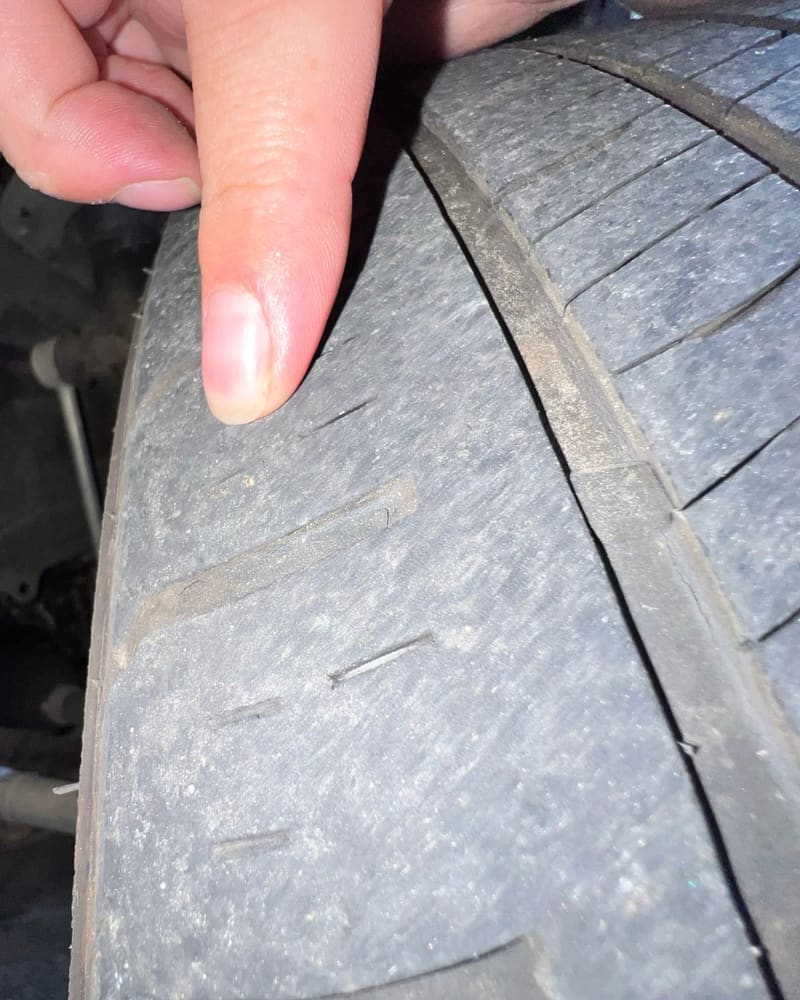
From one of our inspections: the front tire in the story above.
The number on the sidewall is not your tire pressure
The pressure molded into the sidewall is the tire's maximum, not your car's recommended pressure. The same tire can fit many different cars, so the sidewall number is a ceiling for the tire, not a setting for your car.
Your number is on the placard in the driver's door jamb. It gives the right cold pressure, and the front and rear are often different.
Filling to the sidewall number gives a harsher ride, a smaller contact patch, less grip and faster wear in the center of the tread.
A flashing tire light is a different problem from a solid one
A solid light means low pressure. The federal standard calls for the warning to come on when a tire is 25 percent below the carmaker's recommended cold pressure. A quarter of the air is a lot.
A light that flashes for a minute or so when you start the car, then stays on, means the system itself has a fault. A sensor may be dead, missing or not talking to the car.
That second one matters more than people think. It does not mean your tires are low. It means the car can no longer warn you when they are.
Your spare is often the oldest tire on the car
It is out of sight, and it is rarely part of anyone's maintenance routine.
Goodyear, Michelin, Bridgestone, Continental, Pirelli, Toyo, Yokohama, Ford, Nissan and Honda all name the spare in their tire age guidance, and none of the guidance we read gives the spare a longer life than the road tires. A spare can look brand new at ten years old because nobody has driven on it. Tread is not the clock. Age is.
Worth checking:
- Is there one at all? Many newer cars come with a repair kit instead of a spare.
- Is it inflated? Temporary spares often need much more air than the road tires. Check the door placard or the owner's manual for the number.
- How old is it? Read its own date code.
- Is it cracked? Hold it to the same standard as any other tire.
- What type is it? A temporary spare has its own speed and distance limits, printed on the tire or in the owner's manual.
What this means when you are buying a used car
Tires are one of the quickest places to find money on a used car, and an old set can hide behind shiny sidewalls and decent tread.
They also tell you about the rest of the car. Wear in the center usually points to too much air, wear on both edges to too little, wear on one edge to alignment, and a cupped, scalloped pattern to worn shocks or struts.
When we inspect a car, our technician measures the tread depth on each tire, checks each tire's pressure against the door placard, and records each tire's brand and size. Each tire has its own lines in our inspection form for dry rot or cracking, for a bulge in the sidewall, and for age, with the age line set at 6 years or older by the date code. We check the spare too: whether there is one, and if there is, its condition, its tread and whether it is inflated.
Inspections start at $259, and one of our certified technicians comes to wherever the car is in the Atlanta and Orlando metro areas.
Book an inspection, or text or call 833-644-0800.